

Key Takeaways
ECU testing can help establish whether a control unit is faulty, but it is only one part of a sound diagnosis. The right approach depends on the symptoms, the vehicle and the evidence gathered before testing begins.
- Warning lights and fault codes are clues, not proof of ECU failure.
- Wiring, power supplies, grounds, sensors and connectors may cause similar symptoms.
- Bench testing and in-vehicle diagnostics answer different questions and may be used together.
- A useful provider explains the test scope, findings, options, costs and warranty terms.
- Clear symptom notes and vehicle history can make testing more focused.
What professional ECU testing covers
An electronic control unit (ECU) manages functions in a vehicle by receiving information and controlling related systems. Professional testing aims to check whether the unit is operating as expected and to distinguish an internal fault from a problem elsewhere in the vehicle. The exact checks depend on the ECU type, the symptoms and the equipment available.
Fault diagnosis and component-level testing
A diagnosis usually begins with the reported fault, any stored codes and relevant measurements. A code can point toward a circuit or system, but it does not automatically identify a failed ECU; a damaged connector, weak supply or faulty sensor may produce a similar result. Where equipment and access allow, a specialist can assess the unit’s inputs, outputs, communication and internal condition to build a clearer picture.
The aim is to reach a supported conclusion rather than replace a part based on a single clue. That distinction matters because a fault code is evidence, not a verdict. A service description such as ECU testing across Australia can help readers understand the kinds of checks one provider says it performs, while the scope of any individual test should still be confirmed directly.
Bench testing versus in-vehicle diagnostics
In-vehicle diagnostics examine the ECU as part of the connected vehicle, where wiring, sensors and other modules can influence the symptoms. Bench testing removes the unit and connects it to test equipment outside the vehicle. That can make some checks easier to control, but it cannot recreate every condition the unit encounters on the road.
A provider may recommend one method first or use both, depending on what the initial evidence suggests. The useful question is not which method sounds more advanced, but which one can answer the specific diagnostic question.
Testing different ECU types and vehicle systems
ECUs are not limited to engine management. Vehicles may have separate control units for body functions, transmission, braking, instruments and other systems, and each may require different connections or test procedures. Confirm that a provider has experience with the relevant unit and vehicle rather than assuming a test process applies to every module.
A page describing automotive electronic repairs, for example, lists several kinds of modules; that breadth is not a substitute for confirming whether a particular unit and fault are within a provider’s scope. The same principle applies when considering tuning or calibration: WinOLS is described as software tuners use to find and edit ECU maps, which is a distinct activity from fault diagnosis.
When to consider ECU testing
ECU testing may be worth considering when a vehicle has recurring electrical or control-system symptoms and routine diagnosis has not established the cause. It is not usually the first step for every warning light or drivability complaint. Begin with the symptoms and the vehicle’s diagnostic evidence, then decide whether testing the control unit could resolve a specific unanswered question.

Warning lights, fault codes, and performance changes
A warning light, diagnostic trouble code or change in performance can justify further investigation, especially if the problem returns after basic checks. Yet these signs are shared by many faults. An engine misfire, for instance, may arise from ignition, fuel, wiring or sensor issues as well as a control-unit problem; a code should guide testing rather than end it.
The article on common ECU problems discusses symptoms such as starting issues and misfires, but symptoms alone cannot confirm that an ECU is responsible. Note when the issue appears, whether it is consistent and what codes have been recorded. Those details help a technician decide whether ECU-specific testing is warranted.
Starting, stalling, and intermittent electrical issues
A vehicle that cranks without starting, stalls unexpectedly or behaves inconsistently can have an electrical fault, but the source may be outside the ECU. Low battery voltage, poor grounds, damaged wiring and intermittent connections can all complicate diagnosis. Intermittent faults are particularly challenging because a vehicle may behave normally during a brief inspection.
Record the conditions around each event: temperature, rain, engine load, time since starting and any recent repairs. A repeatable pattern can be more useful than a long list of symptoms with no context. If the vehicle is unsafe or unreliable to drive, arrange appropriate assistance rather than trying to reproduce the fault on public roads.
Ruling out wiring, sensors, and other causes first
Before authorising ECU testing, ask what checks have been made on the supporting circuits. A fault attributed to a control unit can sometimes be traced to its power supply, ground, connector, wiring or an input from another component. Working through these possibilities can prevent unnecessary removal or replacement.
A short record of the basic checks helps keep the diagnostic conversation focused:
- Confirm battery condition and charging-system operation.
- Inspect relevant fuses, connectors, grounds and visible wiring.
- Compare fault codes with live data and the reported symptoms.
- Check related sensors or actuators where the evidence points to them.
These steps do not replace specialist diagnosis, and not every check is appropriate for every vehicle. They do, however, help establish what has already been ruled out and what question ECU testing should answer.
How the ECU testing process works
A professional ECU test should follow a clear path from the reported concern to a documented finding. The steps vary with the unit and the provider, but a good process begins with context and explains the limits of the test. Ask how the results will guide the next decision, whether that is further diagnosis, repair or another course of action.
Initial vehicle and fault assessment
The first discussion should cover the vehicle, the ECU or module involved, the symptoms and any diagnostic work already completed. A technician may ask for fault codes, scan results, service history or details of recent repairs. If the unit is being removed and sent for testing, confirm which parts must accompany it and whether the vehicle has specific handling or security requirements.
This initial assessment helps avoid treating an isolated component as if it were the entire vehicle. It also gives the provider a chance to say whether the reported issue fits the test service offered or whether more vehicle-level diagnosis is needed first.
Test setup, simulation, and measurements
For a bench test, the unit is connected using suitable fixtures and test equipment. Depending on the setup, a technician may check communication, inputs and outputs or simulate selected operating conditions. In-vehicle diagnosis instead observes the unit in its normal network, where related components and wiring remain part of the picture.
The methods are not interchangeable, so ask what the test includes and what it cannot establish. If calibration or map editing is being discussed rather than diagnosis, clarify the difference; the description of WinOLS map editing concerns finding and editing ECU maps, not proving that a unit has an internal fault.
Findings, repair options, and verification
A useful report separates observations from conclusions. It should explain what was tested, what the results indicate, any limits or uncertainties, and what options are available next. If a repair is proposed, ask whether the result will be retested and how the vehicle-level fault will be verified after the unit is reinstalled.
For an overview of one possible test and reporting approach, readers can review the described ECU test service. Regardless of the provider, a clear explanation of findings helps you compare the proposed work with the original symptoms and decide whether to proceed.
Bench testing and in-vehicle testing compared
Bench and in-vehicle testing each have a place in diagnosis, and neither is automatically the better choice. Bench work can isolate a removed module under controlled conditions, while vehicle diagnostics preserve the connections and operating conditions that may be essential to an intermittent fault. A technician should be able to explain why a particular method fits the case.
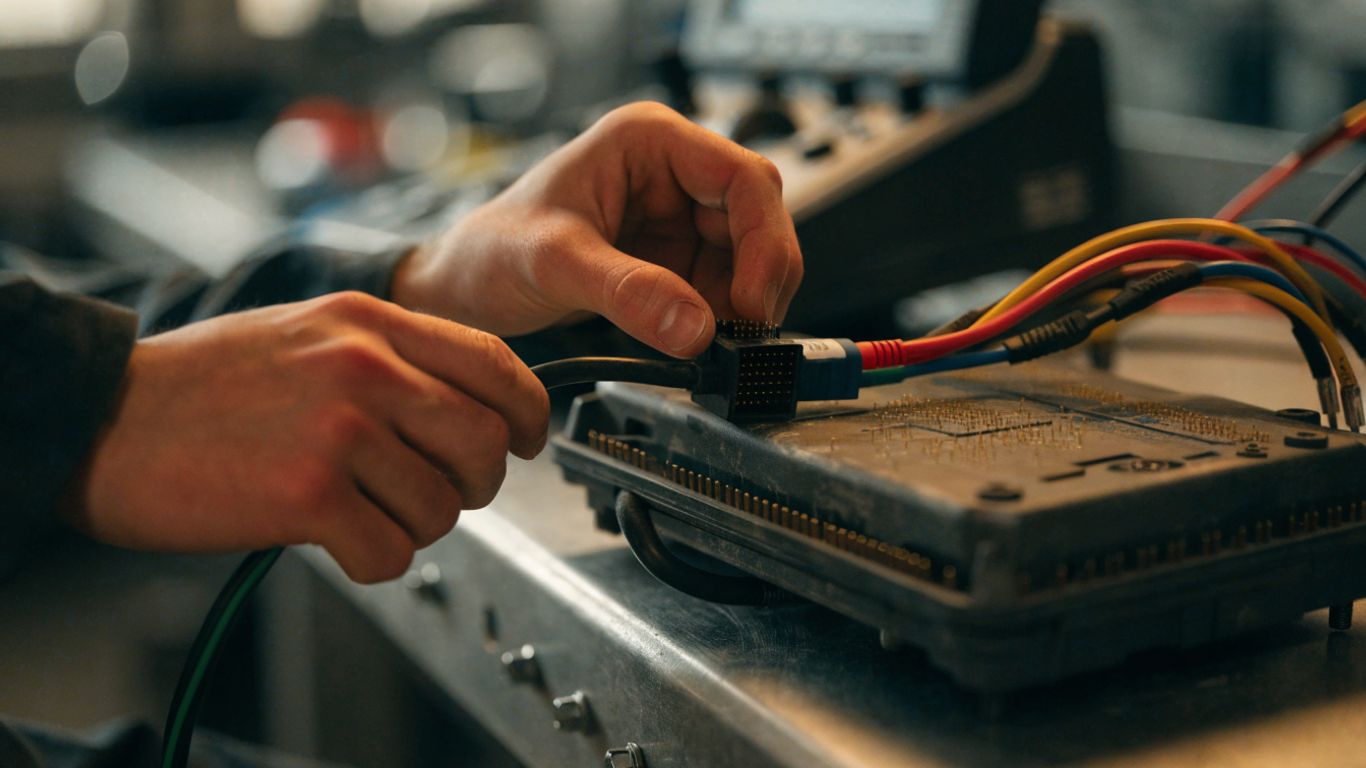
What bench testing can reveal
A bench test can assess whether a removed unit communicates or responds to selected inputs and outputs when connected to suitable equipment. Some setups also simulate operating conditions. This may help identify an internal problem that is repeatable under test, though the exact coverage varies with the module and test rig.
Before sending a unit away, ask whether the test reproduces the conditions associated with the fault and whether the report will distinguish a confirmed failure from a result that remains inconclusive. A bench result is strongest when it is interpreted alongside the vehicle’s symptoms and previous checks.
When in-vehicle diagnostics are more useful
Testing in the vehicle is often more informative when a fault depends on wiring, another module, sensor signals or conditions that a bench setup cannot reproduce. It can also help establish whether the ECU receives the correct power and data while the problem is happening. That context may be lost once the unit is removed.
A bench test may still be useful later, but starting with the vehicle can prevent a misleading conclusion. The choice should reflect where the evidence points, not just convenience or the assumption that one method is always more thorough.
Choosing an approach for intermittent faults
Intermittent problems call for a careful record of when and how they occur. A unit may pass a short bench check yet fail only when hot, exposed to vibration or connected to a particular circuit. Conversely, an in-vehicle fault may appear to implicate the ECU when a loose connection is the real cause.
The comparison below shows what each approach can contribute; it is a guide to the questions to ask, not a guarantee of what a test will find.
| Approach | Useful when | Main limitation |
|---|---|---|
| Bench testing | The removed unit can be connected and assessed under selected conditions | It may not reproduce the vehicle’s full operating environment |
| In-vehicle diagnostics | Wiring, network communication or related components may be involved | The fault may not occur during the inspection |
| Combined approach | Initial results leave a specific question unresolved | It can involve additional time and cost |
In practice, a technician may start with whichever method best tests the leading explanation, then add the other if the evidence remains incomplete. Ask what new information the next step is expected to provide before approving it.
How to choose an ECU testing provider in Australia
Choosing a provider is less about a broad promise than about a clear match between the vehicle, module and fault. Ask how the provider handles your particular unit and what evidence will be included in the result. A useful conversation should leave you understanding the test scope, likely next steps and any uncertainty.
Relevant vehicle and ECU experience
Ask whether the provider has worked with the vehicle make, model, year and ECU type in question. Similar-looking modules can differ in connections, software and test requirements, so broad experience is not the same as experience with the exact unit. Share the symptoms and existing scan results before sending parts or authorising work.
Search results can mix unrelated specialist subjects, so check that a page actually addresses vehicle electronics. ExpressVPN concerns VPN services, Mr Wet Wall Canberra covers bathroom renovation, Mount Dora pain management addresses healthcare, and event power planning concerns rental equipment; none can establish whether a vehicle ECU has failed. For ECU questions, prioritize relevant technical information and direct answers about the unit being tested.
Test equipment, reporting, and repair capabilities
Ask what the provider will test, whether the unit is assessed on a bench or in the vehicle, and what kind of report you will receive. Also clarify whether diagnosis and repair are separate services, whether you must approve repair work after testing, and how the unit will be checked afterward. A provider’s stated capability should be specific enough for you to understand what is and is not included.
The name of a tool or a long list of equipment is less useful than an explanation of how the test relates to your symptoms. Look for findings that distinguish measured results from interpretation, and ask for clarification if a report uses terms you do not understand.
Warranty terms, communication, and turnaround time
Before agreeing to work, check how the provider communicates results, when payment is due and what warranty applies to any repair. Ask whether the warranty covers the repair itself, the part or another defined scope, and whether conditions apply. Turnaround estimates should also clarify whether they include shipping, parts availability and any additional diagnosis.
Good communication is practical, not decorative. You should know who will contact you, what requires further approval and what happens if the test does not confirm an ECU fault. Get important terms in writing so you can compare the proposal with your needs.
Preparing for an ECU test and understanding costs
Preparation helps a provider interpret the unit in the context of the vehicle rather than as an unexplained part. Gather the information you already have and ask what needs to be supplied before the test starts. Costs can vary substantially depending on access, test scope and whether repair or further diagnosis is needed.
Information and vehicle history to provide
Write down the symptoms in plain language, including when they began and how often they occur. Include diagnostic codes, scan reports, recent repairs, battery or electrical work and any circumstances that make the fault appear or disappear. If you are sending a removed unit, verify its identification and follow the provider’s packaging and shipping instructions.
Avoid guessing at a diagnosis when describing the problem. A factual account of what happened gives the technician room to test competing explanations rather than simply confirm an assumed ECU failure.
Factors that affect testing and repair costs
The total cost may depend on the type of unit, how it is accessed, whether testing requires special fixtures, and whether the initial assessment leads to repair or additional work. Shipping, return arrangements, parts and vehicle-level verification may be separate charges. Ask for an itemized estimate and find out whether testing is payable even when the ECU is found to be functioning.
A low initial figure is not necessarily the full cost, just as a higher estimate is not automatically better value. Compare what is included, what could change the estimate and whether you will be contacted for approval before extra work begins.
Questions to ask before authorising work
A few direct questions can make the scope and cost easier to judge. Keep them specific to your vehicle and the reported fault, and ask for a written answer if the terms are complex.
- What checks will be performed, and what is outside the test scope?
- Will the test be on the bench, in the vehicle, or a combination?
- What will the report tell me if no internal fault is found?
- Are diagnosis, repair, shipping and verification priced separately?
The answers should clarify both the likely next step and the possibility that testing points away from the ECU. If that possibility is not discussed, ask how the provider will handle an inconclusive result before you authorise the work.
Conclusion
Professional ECU testing is most useful when it answers a defined question within a wider diagnostic process. Start with the symptoms, check the surrounding circuits and choose bench or in-vehicle testing according to the evidence. A provider who explains the scope, findings, costs and warranty clearly can help you make a more informed decision without treating a fault code as proof of ECU failure.
Frequently Asked Questions
What does ECU testing involve?
It can involve checking communication, inputs, outputs and selected operating responses, either on a bench or in the vehicle. The exact checks depend on the unit, equipment and reported fault.
Does a fault code mean the ECU is faulty?
No. A code identifies a detected condition or circuit concern, but wiring, power, grounds, sensors and other components may cause similar symptoms. Further diagnosis is needed to establish the cause.
Can an ECU pass a bench test and still have a problem in the vehicle?
Yes. A bench test may not recreate every temperature, vibration, wiring or network condition present in the vehicle. Results should be interpreted alongside the symptoms and vehicle checks.
Should wiring be checked before ECU testing?
Often, yes. Checking relevant power supplies, grounds, connectors and wiring can help rule out common causes that might otherwise be mistaken for an internal ECU fault.
How long does ECU testing take?
Timing varies with the module, test method, provider workload and whether parts or further diagnosis are needed. Ask whether the estimate includes shipping and when you will receive the findings.
What information should I provide to a testing provider?
Share the vehicle details, symptoms, diagnostic codes, previous repairs and conditions associated with the fault. If sending a unit, confirm identification and packaging requirements first.
Is ECU repair always possible after testing?
No. Testing may find a repairable fault, indicate another cause or produce an inconclusive result. Ask the provider to explain the findings and obtain approval before any repair or additional work begins.