

Key Takeaways
Low voltage can imitate engine, sensor, and computer faults, especially during cranking. Testing the battery, charging system, grounds, and voltage drops in the right order helps prevent unnecessary parts replacement.
- A weak battery can cause slow cranking, no-starts, warning lights, and unstable engine operation.
- Alternator, regulator, wiring, ground, and parasitic-drain problems can all create low voltage.
- Voltage-drop testing can reveal resistance that a basic battery test misses.
- A code alone does not prove that the ECU has failed.
- Repair the underlying electrical fault before replacing or reprogramming the engine computer.
How low voltage affects the engine computer
The engine computer, often called the ECU or ECM, depends on a reasonably stable supply voltage and reliable ground. When that supply falls outside the computer’s operating range, it may stop processing inputs correctly, reset, or lose communication with other modules. The result can look like a mechanical problem even when the engine itself is sound.
The ECU’s role in engine operation
The ECU receives information from sensors and uses it to control functions such as fuel delivery, ignition timing, idle speed, and emissions systems. It also exchanges data with other vehicle modules. Because so many decisions depend on electrical signals, a power-supply problem can affect several systems at once rather than producing one clean, isolated symptom.
Why startup voltage matters
Starting places the vehicle’s greatest short-term electrical demand on the battery. The starter draws heavily while the ECU and ignition systems still need usable voltage to operate. If the battery is weak or a cable has excessive resistance, voltage at the computer can fall sharply during cranking, producing a slow start, a no-start, or a temporary loss of communication.
How voltage instability disrupts data signals
Sensors do not work in isolation. They send changing electrical signals that the ECU interprets against reference voltages and ground values. A poor ground, damaged power feed, or unstable alternator output can make those signals appear implausible, causing several unrelated trouble codes or intermittent behavior. A voltage-drop test is useful here because it checks what the component actually receives while current is flowing.
When low voltage causes permanent damage
Most low-voltage events cause temporary malfunction rather than immediate computer destruction. Permanent damage is more often associated with a severe electrical event, reversed polarity, incorrect jump-starting, or a voltage spike from a charging-system fault. If the vehicle repeatedly loses power, resets modules, or develops faults after electrical work, stop repeated jump-start attempts and have the system tested.
A stable supply is the first priority; replacing the ECU before confirming power and ground can leave the original problem untouched. Test the power path first so a computer is not blamed for a fault elsewhere.
Common symptoms of engine computer voltage problems
Voltage-related problems rarely announce themselves with one unmistakable sign. They often appear as a cluster: difficult starting, dim or flickering lights, warning lamps, rough running, and scan-tool communication issues. The timing matters too, especially if symptoms began after a discharged battery, jump-start, or recent terminal repair.

Hard starting or no-start conditions
A starter that turns slowly is an obvious clue, but normal-sounding cranking does not completely rule out a voltage problem. The battery may maintain enough power to turn the engine while voltage at the ECU drops too far for reliable control. A no-start after the vehicle has sat overnight, particularly with dim lights or repeated clicking, deserves a battery and connection test before deeper engine diagnosis.
Stalling, misfires, and rough running
An ECU that resets or receives unstable sensor signals may interrupt normal fuel and ignition control. The driver may notice a stall at idle, hesitation under load, misfires, or a rough-running engine that improves and worsens without a clear pattern. These symptoms can also have mechanical or fuel-system causes, so voltage testing should accompany—not replace—normal engine diagnosis.
Check engine lights and multiple warning codes
A low-voltage event can set codes across several systems because modules may lose communication or record sensor values outside their expected range. A check-engine-light explanation can help put that pattern in context, but the warning light itself does not identify the failed part. Record the codes and freeze-frame information before clearing anything.
Intermittent electrical and communication faults
Intermittent faults are common when a connection is barely conducting or a module repeatedly loses its supply. Gauges may behave oddly, accessories may cut out, or a scan tool may connect only intermittently. If several modules report communication errors at the same time, inspect shared power and ground circuits before treating each code as a separate failure.
What causes low voltage in a vehicle
Low voltage is a symptom of an electrical-system problem, not a diagnosis by itself. The cause may be energy stored in the battery, energy produced by the alternator, or resistance in the path between those components and the ECU. Careful testing separates those possibilities.
Weak, aging, or damaged batteries
A battery can show an acceptable open-circuit voltage and still fail when asked to deliver starting current. Age, internal damage, low electrolyte level in serviceable designs, extreme temperatures, and repeated deep discharges can reduce its effective capacity. Terminal corrosion or a loose clamp can create the same practical result by restricting current flow.
Failing alternators and voltage regulators
The alternator must replenish the battery and support electrical loads after the engine starts. A worn alternator, slipping belt, damaged diode, or faulty regulator can leave the battery undercharged or produce unstable output. A battery that repeatedly goes flat may therefore be a consequence of a charging fault rather than the original cause.
Loose, corroded, or damaged connections
Resistance in a positive cable, ground strap, fuse connection, relay, or connector can consume voltage before it reaches the ECU. Corrosion may be hidden inside a cable end or beneath insulation. Inspecting only the battery terminals is not enough; the complete supply and ground path must be considered under load.
Parasitic battery drains and excessive electrical loads
A vehicle that loses charge while parked may have a light, accessory, control module, or aftermarket device remaining active. Excessive loads while driving can also expose a marginal charging system. Useful clues include a battery that is dead after sitting, repeated need for jump-starts, or symptoms that appear when the blower, rear defroster, headlights, and other loads operate together.
When checking for an overnight drain, technicians typically allow the vehicle to enter its sleep state and then measure current according to the vehicle maker’s procedure. Common areas to investigate include:
- Interior, glove-box, and trunk lights that remain on.
- Aftermarket stereos, alarms, trackers, or remote-start equipment.
- Modules that fail to shut down after the vehicle is locked.
- A shorted diode or charging component that allows reverse current flow.
These checks should be performed with the correct meter setup and precautions. Disconnecting cables or opening circuits carelessly can wake modules, erase information, or damage a meter fuse.
How to diagnose low voltage safely
Begin with basic measurements before interpreting codes or condemning an ECU. Use a digital multimeter rated for automotive work, avoid shorting terminals, and keep hands, leads, and clothing clear of belts and fans when the engine is running. If a battery is swollen, leaking, frozen, or visibly damaged, do not charge or test it casually.
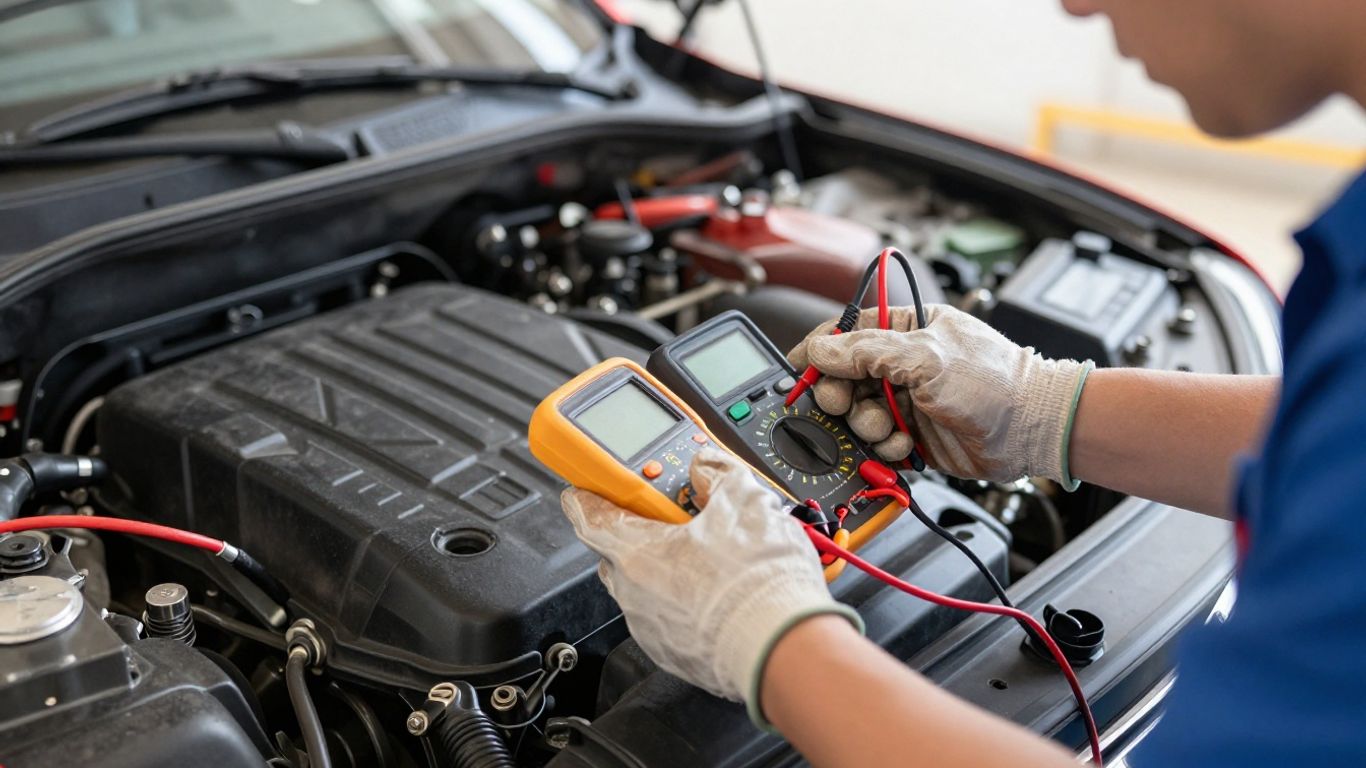
Testing battery voltage with the engine off
Let the vehicle rest with the ignition off, then measure directly across the battery posts rather than only across the cable clamps. The reading indicates the battery’s state of charge, but it is not a complete health test. A proper load or conductance test may be needed to determine whether the battery can sustain starting demand.
Checking charging voltage while running
With the engine running, measure at the battery and observe the reading with electrical loads switched on. The exact expected range varies by vehicle and charging strategy, so compare the result with manufacturer specifications. A reading that stays low, fluctuates abnormally, or changes sharply with load supports further alternator, regulator, belt, and cable testing.
The following pattern can help organize the first measurements, though specifications always take priority:
| Test condition | What it checks | Concerning pattern | Next step |
|---|---|---|---|
| Engine off after resting | Battery charge state | Low reading | Charge and test battery |
| Cranking | Starting-system voltage behavior | Sharp voltage collapse | Test battery and cables |
| Engine idling | Charging output | Little or no rise | Check alternator system |
| Running with loads | Capacity under demand | Large drop or fluctuation | Test output and voltage drops |
The table is a starting framework, not a substitute for vehicle-specific specifications. Compare measurements taken at the battery with measurements taken at ECU power and ground points; that difference often reveals where the supply is being lost.
Performing a voltage-drop test
A voltage-drop test measures unwanted resistance while the circuit is carrying current. Place the meter across the section being tested—for example, between the battery positive post and the ECU’s power feed during cranking or between the ECU ground and the battery negative post. A larger-than-expected reading points toward a cable, terminal, fuse, relay, splice, or ground connection that needs attention.
Testing only for continuity can miss this fault because a wire may pass a small amount of current yet fail under load. Repeat the measurement after cleaning or repairing the connection so the repair is confirmed rather than assumed.
Inspecting grounds, fuses, and power feeds
Follow the wiring diagram for the vehicle and identify every ECU power feed, ground, fuse, relay, and shared splice. Check for heat damage, loose terminals, moisture, green corrosion, and aftermarket wiring. A fuse should be tested for voltage on both sides under the relevant operating condition; visual inspection alone can miss a poor fuse-holder connection.
How to distinguish voltage problems from ECU failure
An ECU should be considered only after its power, grounds, communication lines, and related inputs have been verified. Low voltage can create misleading codes, while a genuine computer fault can also be intermittent. The distinction comes from repeatable measurements and a fault that remains after the vehicle’s electrical supply is corrected.
Clearing codes and checking whether they return
Save all diagnostic information before clearing codes, including freeze-frame data and module communication complaints. After repairing a confirmed voltage issue, clear the codes with the appropriate scan tool and run the required drive cycle or functional checks. Codes that return immediately under known-good voltage deserve closer circuit and component testing; codes that stay away may have been caused by the original low-voltage event.
Comparing scan-tool data with measured voltage
Scan-tool voltage data can show what a module believes it is receiving, but it should be compared with a meter reading at the relevant circuit. A disagreement may indicate a supply drop, ground problem, measurement-point difference, or scan-data limitation. Do not use a single screen value as proof that the ECU itself is defective.
Testing ECU power, ground, and communication circuits
Use the wiring diagram and back-probe procedures recommended for the vehicle. Confirm power feeds under the conditions in which the fault occurs, including cranking if appropriate, and check ground integrity with a loaded voltage-drop test. Communication faults require correct procedures for the vehicle network; indiscriminate probing or applying power to data lines can cause additional damage.
Recognizing signs of internal computer damage
Internal ECU damage becomes more plausible when verified power and ground remain stable, communication wiring is sound, related sensors and actuators test correctly, and the same computer-specific fault returns. Water intrusion, burned components, a damaged connector, or a failure that follows the module are useful clues. Professional module testing or manufacturer-level diagnosis may be needed before replacement.
How to fix and prevent low-voltage engine computer problems
The repair should follow the confirmed cause, not the most expensive symptom. Restore battery capacity, charging performance, and circuit integrity first, then clear and retest the vehicle. This order reduces the chance of installing a replacement computer that is exposed to the same electrical fault.
Replacing or charging the battery correctly
Use a battery with the correct specifications and fitment for the vehicle. Charge it with a suitable charger, observe the manufacturer’s safety instructions, and allow vehicles that require battery registration or adaptation to complete that procedure. A replacement battery will not solve a persistent drain or charging fault, so retest the system after installation.
Repairing alternator and charging-system faults
Inspect the belt, tensioner, alternator connections, fusible links, and regulator control circuit. Replace or repair the failed component, then verify output under normal and increased electrical load. If charging voltage is excessively high, address it promptly because overvoltage can harm electronic modules as well as the battery.
Cleaning and securing electrical connections
Disconnect the battery using the vehicle’s prescribed procedure before servicing terminals or sensitive connectors. Clean corrosion from suitable connection surfaces, replace damaged clamps or cables, and tighten fasteners to specification. Do not rely on grease to compensate for a loose connection; protection comes after the metal-to-metal connection is sound.
Protecting the ECU from future voltage spikes
Use correct jump-start polarity, avoid improvised high-current charging practices, and follow the vehicle maker’s instructions when welding or installing accessories. Secure aftermarket wiring with proper fusing and grounding. If a vehicle has suffered repeated electrical events, inspect the charging system and module grounds again rather than assuming the latest symptom is unrelated.
For operators managing vehicles in the field, electrical downtime is only one part of a wider maintenance process. Separate guidance on a field service cancellation framework may be useful for dispatch planning, while technical SEO services belong to website operations rather than vehicle repair and should not be confused with diagnostic work. Similarly, wedding backup planning and helium balloon safety address unrelated forms of preparation, and shaving irritation care is not an automotive remedy.
Conclusion
Low voltage causing engine computer failure is often a preventable electrical-system problem rather than proof that the ECU is beyond repair. Start with the battery, charging output, voltage drops, grounds, and power feeds; preserve diagnostic data; and replace the computer only after those checks support that conclusion.
Frequently Asked Questions
Can low voltage damage an engine computer?
It can cause resets, communication failures, and incorrect readings, but many low-voltage symptoms are temporary. Permanent damage is more likely after severe overvoltage, reversed polarity, or a major electrical event.
Can a weak battery cause a no-start?
Yes. A weak battery may not maintain enough voltage for the starter, ignition, fuel, and engine computer during cranking. Cable resistance can create the same symptom.
Can low voltage turn on the check engine light?
Yes. A voltage interruption can cause modules to store communication or sensor-related codes. The codes should be saved and interpreted alongside battery and charging-system test results.
What voltage should a car battery show when it is off?
The expected reading depends on charge state, temperature, and battery condition. An open-circuit reading is only a preliminary check; a load or conductance test may still be necessary.
How do I know whether the alternator or battery is bad?
Test the battery independently, then check charging performance with the engine running and electrical loads applied. A battery that repeatedly discharges may be affected by either a weak battery, inadequate charging, or a parasitic drain.
What is a voltage-drop test?
It measures voltage lost across a cable, connection, ground, fuse, or other part of a live circuit under load. Excessive loss indicates unwanted resistance that a simple continuity check may miss.
Should I replace the ECU after low-voltage codes appear?
Usually not immediately. Verify battery condition, alternator output, power feeds, grounds, communication circuits, and related components first. Replace or professionally test the ECU only when the evidence points to an internal fault.