

Key Takeaways
An ECU can cause a misfire, but a misfire code alone does not prove the ECU is defective. A careful diagnosis starts with the basics and works toward the control unit.
- An ECU misfire may result from incorrect ignition or injector commands.
- Power, ground, wiring, and sensor faults can mimic ECU failure.
- Spark, fuel, air, compression, and timing should be checked first.
- Scan data and control-signal testing are more useful than guesswork.
- Continued driving with an active misfire can damage the catalytic converter.
How ECU failure can cause an engine misfire
An engine misfire caused by ECU failure occurs when the control unit cannot reliably manage the combustion event. The fault may affect ignition timing, injector operation, sensor interpretation, or communication with another module. Still, the ECU is only one part of a much larger system, so diagnosis should move from simple causes to complex ones.
The ECU’s role in ignition and fuel control
The ECU receives information from sensors such as the crankshaft and camshaft position sensors, then uses that information to control ignition and fuel delivery. It determines when an ignition event should occur and how the injectors should be commanded. If the inputs are wrong or the output stage is damaged, combustion may become inconsistent.
That control is continuous rather than one-time. The unit adjusts its decisions as engine speed, load, temperature, and throttle position change. A fault that appears only when the engine is hot or under load may therefore be harder to identify than a complete electrical failure.
How incorrect injector or ignition commands create misfires
A spark that arrives at the wrong time can fail to ignite the mixture effectively. Likewise, an injector command that is missing, weak, or irregular can leave a cylinder with too much or too little fuel. The result may feel like a stumble, shake, hesitation, or uneven acceleration.
The most useful question is not simply whether a misfire code is present, but whether the ECU is sending the correct command and whether the component receives it. That distinction prevents a control problem from being confused with a failed coil, injector, or circuit.
The difference between a complete ECU failure and a partial fault
A complete ECU failure may produce a no-start condition, loss of communication, or several unrelated system faults at once. A partial fault can be much less obvious: one injector driver, ignition channel, or internal circuit may work intermittently while the rest of the engine continues running.
Partial faults often create patterns that change with temperature, vibration, or electrical load. They can also appear as a single-cylinder misfire or as several misfires that share a circuit. A repeatable fault pattern matters because it helps connect the symptom to a particular control path.
Why wiring, power, and ground issues can mimic ECU failure
An ECU cannot produce dependable commands if its supply voltage is low or its ground connection has excessive resistance. Damaged harnesses, loose terminals, corrosion, and water intrusion can interrupt a signal in ways that look like an internal computer fault.
Before condemning the unit, inspect the relevant fuses, grounds, connectors, and harness sections. A voltage drop test under operating conditions is often more revealing than a visual inspection alone. A useful misfire diagnosis guide can reinforce this basic, step-by-step approach without encouraging unnecessary parts replacement.
Symptoms that point to an ECU-related misfire
The symptoms of an ECU-related misfire overlap with those of ordinary ignition, fuel, and mechanical faults. What makes an ECU suspect is usually the combination of symptoms, their timing, and the test results behind them. A driver’s description is valuable, but it should be paired with scan data and circuit checks.
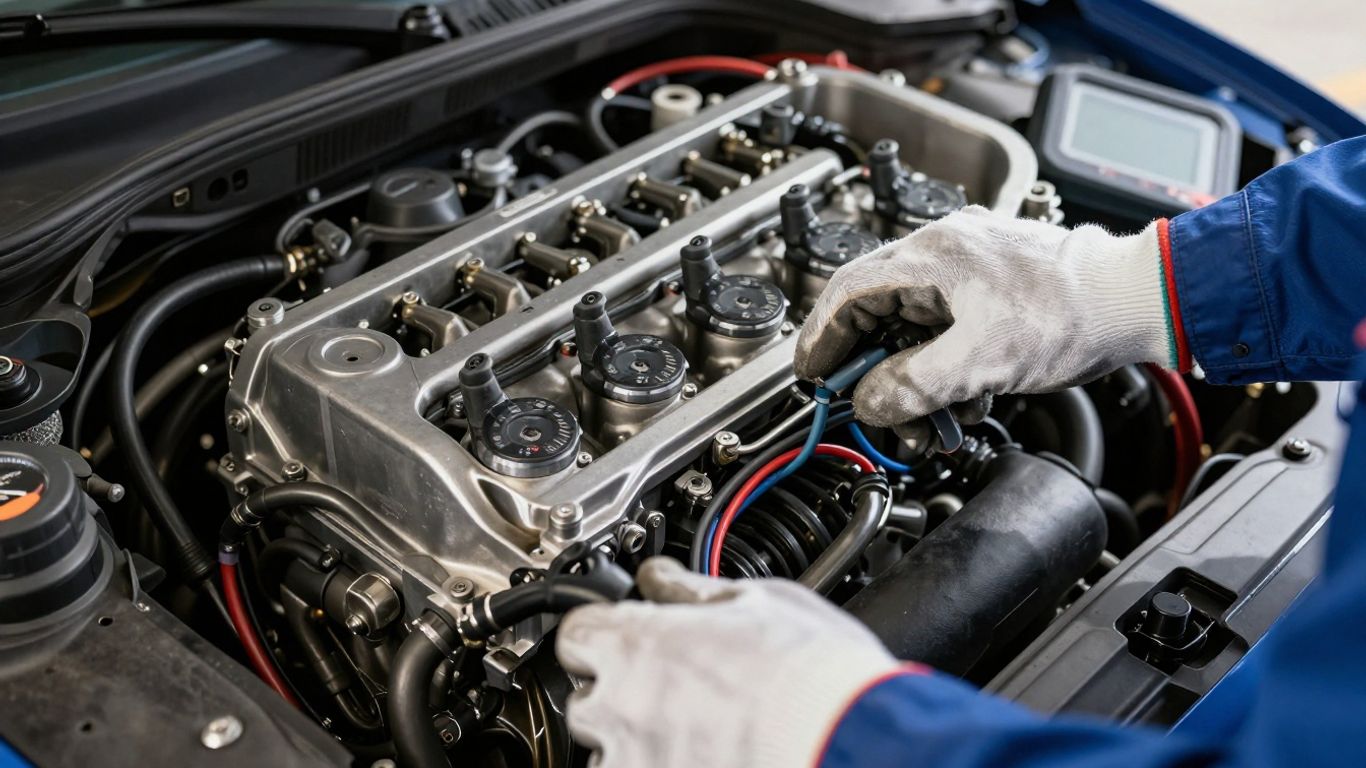
Check engine light patterns and diagnostic trouble codes
A steady check engine light may accompany a fault that needs attention but is not currently causing severe catalyst damage. A flashing light generally indicates an active misfire serious enough to warrant reducing engine load and seeking help promptly. Codes can identify a cylinder or circuit, but they rarely identify the failed part by themselves.
Codes related to communication, internal control modules, sensor plausibility, or several cylinders may increase suspicion of an ECU or shared circuit. Even then, the code should be confirmed with electrical testing. A systematic ECU troubleshooting approach is useful here because it keeps the code from becoming the diagnosis.
Rough idling, hesitation, and loss of engine power
A misfiring engine may shake at idle, hesitate when the throttle opens, or lose power during acceleration. These symptoms can appear when an ignition command breaks down, but they can also result from weak fuel delivery, an air leak, or low compression.
Record when the problem occurs. A fault limited to cold starts, hot restarts, heavy load, or wet weather gives the technician a better path than a general report that the car “runs badly.”
Misfires affecting one cylinder versus multiple cylinders
A single-cylinder misfire often directs attention toward that cylinder’s plug, coil, injector, wiring, or compression. Multiple cylinders may point toward a shared power supply, fuel problem, timing issue, sensor input, or control-unit circuit. The pattern is suggestive, not conclusive.
Cylinder counters in live data can reveal whether the misfire stays in one place or moves. If a fault follows a component swap, the component becomes more likely; if it stays with the same cylinder, wiring or mechanical causes deserve closer attention.
Stalling, hard starting, and inconsistent engine behavior
Stalling and hard starting can occur when the ECU loses a critical position signal or fails to maintain ignition or injection control. Intermittent behavior is especially difficult because the vehicle may operate normally during a brief inspection. Save freeze-frame data and note whether electrical accessories, engine temperature, or vibration change the symptom.
A vehicle that repeatedly stalls in traffic is not merely inconvenient. It can become unsafe, and continued attempts to restart it may obscure the original fault by creating low-battery voltage or additional codes.
How to distinguish ECU failure from common misfire causes
Most misfires are diagnosed by separating the four basic requirements for combustion: spark, fuel, air, and compression. The ECU influences several of these, but it does not make every component in those systems reliable. Start with evidence that can be reproduced and measured.
Faulty spark plugs, ignition coils, and plug wires
Worn, fouled, cracked, or incorrectly gapped spark plugs can cause a misfire without any ECU involvement. A weak ignition coil or damaged plug wire can behave similarly, especially under load when the required voltage rises. Inspecting and testing these parts is usually faster and less expensive than replacing a control unit.
A component swap can be informative when performed carefully. Move a suspect coil to another cylinder, clear the codes, and see whether the misfire follows it. Use the vehicle’s service information for the correct procedure rather than swapping parts blindly.
Clogged or failing fuel injectors
An injector that is restricted, stuck, or electrically open can leave one cylinder lean or unfueled. Checking injector resistance, power supply, and control pulse helps separate an injector problem from an ECU driver problem. Fuel pressure and delivery should also be verified where appropriate.
If the command reaches the injector but fuel delivery is poor, the ECU is not the first suspect. If the injector and its wiring test correctly but the command is absent, the control circuit deserves further testing.
Vacuum leaks and air-fuel mixture problems
Unmetered air can make the mixture too lean, often producing rough idle and cylinder-specific symptoms near the leak. Intake gaskets, hoses, and vacuum-operated components should be inspected, with smoke testing used when a leak is difficult to locate.
Mixture problems may affect several cylinders and can change with engine speed. That behavior is different from a dead control channel, although a sensor reading that is implausible can cause the ECU to make poor fueling decisions.
Compression loss and mechanical engine faults
A valve that does not seal, a damaged piston, worn rings, or a timing problem can create a persistent misfire even when spark and injector commands are correct. Compression testing, leak-down testing, and valve-timing checks help identify these faults.
Mechanical problems often stay with the same cylinder and may produce unusual cranking behavior or exhaust noise. No software update or ECU replacement can correct a cylinder that cannot build or retain compression.
Crankshaft and camshaft sensor problems
The ECU relies on crankshaft and camshaft position signals to synchronize ignition and injection. A failing sensor, damaged reluctor, poor connector, or intermittent harness can therefore look like an ECU failure. Symptoms may include stalling, difficult starting, tachometer irregularities, or multiple timing-related codes.
Compare the sensor signals with the manufacturer’s expected waveform and inspect synchronization in live data. Replacing a sensor without checking its wiring can leave the actual fault untouched.
How to diagnose an ECU-related engine misfire
Diagnosis should establish what the ECU knows, what it commands, and what the engine actually does. A scan tool is helpful, but it is only one instrument in the process. The strongest conclusion comes from several tests that agree with one another.
Scanning for misfire and communication trouble codes
Begin by recording all stored, pending, and history codes before clearing anything. Note freeze-frame conditions, cylinder misfire counters, battery voltage, and whether communication with the ECU or other modules is interrupted. A single P030x code is a starting point, not proof of computer failure.
Look for related codes that explain the misfire, such as sensor, voltage, injector-circuit, or communication faults. After repairs, clear codes only when the information has been documented and a retest is ready.
Checking ECU power supplies, grounds, and wiring
Use a wiring diagram to identify every relevant power and ground path. Check voltage with the circuit loaded, inspect ground voltage drop during cranking and operation, and gently test harnesses for intermittent opens. Connectors should be examined for pushed-back terminals, moisture, oil, and corrosion.
This is also where a broader ECU failure prevention checklist can help organize inspections around water intrusion, sensors, and software-related concerns. The checklist supports the process; it does not replace vehicle-specific wiring information.
Testing ignition and injector control signals
A technician can test for ignition trigger signals, injector pulse, coil power, and circuit integrity with the correct meter, test light, oscilloscope, or manufacturer-approved equipment. The test must distinguish a missing command from a command that is present but unable to drive the component.
High-voltage ignition testing requires caution, and probing the wrong circuit can damage sensitive electronics. Follow the service procedure and back-probe only where the connector and tool allow it.
Comparing live data across cylinders
Live data can show misfire counts, fuel trims, engine speed, synchronization, oxygen-sensor response, and other operating values. Comparing cylinders under the same conditions helps reveal whether the fault is isolated or shared. A control-unit suspicion becomes stronger when the data and circuit tests point to the same output.
Interpretation still depends on the vehicle and the conditions in which the data was recorded. A reading outside a generic online range is not enough to condemn a component.
Using component swaps and circuit testing carefully
Swapping a known-good component can be a useful diagnostic experiment, but only when the parts are compatible and the result is recorded. Do not swap an ECU casually, since it may require programming and can introduce immobilizer or communication issues.
A practical sequence is to verify the symptom, test the easiest external causes, measure the circuit, and only then evaluate the ECU itself. That sequence is safer than replacing expensive parts in response to a code alone.
When ECU repair or replacement is necessary
ECU repair or replacement should follow evidence of an internal fault, not simply a persistent misfire. The decision depends on the failed circuit, the vehicle’s programming requirements, the condition of the unit, and the availability of a properly matched replacement. Documenting the tests makes the repair easier to justify.
Signs the ECU hardware may be damaged
Possible signs include visible water or heat damage, burnt circuit areas, repeated internal-module codes, loss of a confirmed output driver, or a failure that remains after external power, ground, wiring, and component checks pass. These signs are not universal, and some require specialized bench testing.
A control unit should be removed and opened only by someone equipped to protect it from static discharge and further damage. External contamination should also be traced to its source before a repaired unit is installed.
Software errors, corrupted programming, and relearn requirements
A software issue may produce implausible data, communication faults, incorrect control behavior, or a problem that begins after a programming event. The correct response may be a verified software update, reprogramming, or a required relearn rather than hardware replacement.
Battery voltage must remain stable during programming. If a procedure specifies throttle, crank, cam, or idle relearning, skipping it can leave the vehicle running poorly even after the original fault is corrected.
Repairing the ECU versus installing a replacement unit
Repair may make sense when a qualified specialist can identify and correct a failed internal circuit. Replacement may be appropriate when the board is severely damaged, repair is unavailable, or the unit cannot be economically restored. Either route requires confirming that the original failure did not come from an external short or voltage event.
Ask what testing is included, whether the unit is returned with the vehicle’s data, and what programming the installer must complete. A replacement that is electrically sound but incorrectly configured is not a finished repair.
Immobilizer matching and vehicle-specific programming
Many vehicles require the ECU to be matched to the immobilizer, keys, or other control modules. Vehicle identification, software level, configuration data, and security procedures can all matter. The exact requirements vary by model and year.
Do not assume that a physically identical unit will start the engine. Confirm compatibility before purchase and make sure the final programming procedure is available for that vehicle.
Why a professional diagnostic opinion may be worthwhile
Intermittent electrical faults and module failures can consume more time than the replacement part costs. A professional can access wiring diagrams, manufacturer procedures, waveform equipment, programming tools, and test modules that are not available to every owner.
A second opinion is particularly sensible when a shop recommends an ECU without showing power, ground, wiring, and output tests. Clear evidence protects both the vehicle and the repair budget.
Repairing and preventing recurring misfires
The best repair is the one that removes the cause rather than quieting the symptom temporarily. Once the misfire is fixed, the surrounding electrical and mechanical conditions should be checked so the problem does not return. Prevention is mostly careful inspection and stable voltage.
Addressing the underlying cause before replacing the ECU
A replacement ECU will not solve a vacuum leak, failing coil, restricted injector, poor compression, or damaged sensor harness. It may also be damaged by the same short circuit or voltage problem that harmed the original unit. Resolve the external cause first and verify the circuit afterward.
Keep a record of codes, test results, parts replaced, and operating conditions. This makes recurring faults easier to compare instead of treating each episode as unrelated.
Inspecting connectors for moisture, corrosion, and loose pins
Connectors near the engine are exposed to heat, vibration, fluids, and water. Look for green corrosion, bent or recessed pins, broken locks, stretched terminals, and evidence of water tracking along the harness. Repair terminals properly rather than relying on a temporary twist or tape wrap.
After cleaning or repairing a connector, confirm that the terminal grips correctly and that sealing components are intact. Moisture protection is part of the repair, not an optional cosmetic step.
Protecting the ECU from voltage spikes and poor grounding
Weak batteries, failing alternators, reversed jump leads, and poor grounds can expose electronic modules to abnormal voltage. Check charging voltage, battery condition, engine-to-chassis grounds, and the condition of the main power connections.
Avoid disconnecting the battery or plugging modules in while circuits are energized unless the service procedure permits it. Stable electrical supply is one of the simplest ways to reduce repeat failures.
Verifying the repair with road testing and code monitoring
After the repair, allow the engine to reach operating temperature and reproduce the conditions that originally triggered the misfire. Monitor misfire counters, fuel trims, synchronization, and pending codes while driving safely. A short idle check alone may miss a load-related fault.
Use a gradual road test and stop if the check engine light flashes or the engine loses substantial power. The repair is complete only when the original symptom is gone and the relevant monitors behave normally.
When continued driving could damage the catalytic converter
An active misfire can send unburned fuel into the exhaust, where excess heat may damage the catalytic converter. A flashing check engine light, strong shaking, raw-fuel odor, or severe power loss is a reason to reduce driving rather than push through the trip.
If the vehicle is unsafe or repeatedly stalls, arrange a tow. Continuing to drive can turn a manageable ignition or control fault into a more expensive exhaust-system repair. Even unrelated household problems, such as garage fire smoke damage, require attention to hidden secondary effects; automotive misfires deserve the same practical caution.
A disciplined diagnosis also depends on communicating observations clearly. Describe symptoms, timing, warning-light behavior, and previous repairs rather than guessing at the failed part; that is much like giving effective manager feedback, where specific behavior is more useful than a vague judgment. For general travel or comfort decisions, a duvet comforter guide, Medellín food guide, or Costa Rica condo guide belongs to a different subject, but the same principle applies: specific conditions lead to better decisions than assumptions.
Conclusion
An engine misfire caused by ECU failure is possible, but it should be proven through a structured process that checks spark, fuel, air, compression, sensors, wiring, power, and ground before replacing the control unit. Careful testing identifies the real fault, avoids unnecessary expense, and reduces the risk of catalytic-converter or repeat electrical damage.
Frequently Asked Questions
Can an ECU really cause an engine misfire?
Yes. An ECU can cause a misfire if it sends incorrect ignition or injector commands, misinterprets sensor inputs, or develops a fault in an output circuit. External wiring and power problems can create the same symptoms.
Does a misfire code prove the ECU is bad?
No. A misfire code identifies combustion irregularity or a related circuit condition, not necessarily the failed component. Spark plugs, coils, injectors, vacuum leaks, sensors, and mechanical faults are common alternatives.
What are the most common signs of an ECU-related misfire?
Possible signs include recurring misfires, stalling, hard starting, multiple-cylinder faults, communication codes, and inconsistent behavior. These symptoms overlap with many other problems, so testing is required.
Should I replace the ECU after replacing spark plugs and coils?
Not automatically. Confirm fuel delivery, compression, sensor signals, wiring, power, grounds, and ECU output commands before considering replacement. A parts swap without a test result can lead to unnecessary expense.
Can a bad crankshaft sensor look like ECU failure?
Yes. The ECU needs crankshaft and camshaft position information to synchronize ignition and injection. A faulty sensor, damaged reluctor, or poor connection can cause stalling, hard starting, and misfires.
Is it safe to drive with an active engine misfire?
A mild fault may allow limited travel, but a flashing check engine light, severe shaking, raw-fuel smell, or major power loss warrants stopping. Unburned fuel can overheat and damage the catalytic converter.
How is an ECU replacement programmed?
The exact procedure depends on the vehicle. A replacement may need software configuration, immobilizer matching, key or module synchronization, and relearn procedures before the engine will start and run correctly.