

Key Takeaways
A good battery does not eliminate every electrical or fuel-related starting fault. Work from the symptoms toward proof before condemning the ECU.
- Separate a no-crank problem from a crank-no-start problem.
- Check battery performance, grounds, fuses, relays, and starter circuits first.
- Use scanner communication and stored codes as evidence, not as a verdict.
- Inspect for water, corrosion, voltage damage, and programming problems.
- Have module replacement or immobilizer work handled with the correct equipment.
Understand what an ECU-related no-start condition means
When a car won’t start but battery is good ECU problem is on the list, but it is rarely the first conclusion to make. The engine control unit is one part of a larger starting system that includes power supplies, sensors, fuel delivery, ignition, and security controls. A diagnosis becomes much clearer when you identify exactly what the engine does when the key or start button is used.
What the ECU controls during engine startup
During startup, the ECU uses information from sensors to determine when to deliver fuel and command ignition. It may also exchange information with other modules before allowing the engine to run. If it lacks a required power feed, ground, sensor signal, or security authorization, the engine can crank without firing.
That does not mean the ECU itself has failed. A damaged connector or missing crankshaft signal can produce a similar result while the module remains healthy.
How an ECU fault differs from a weak battery
A weak battery often causes slow cranking, clicking, dimming lights, or a sharp drop in voltage when the starter engages. An ECU-related fault may leave cranking speed fairly normal while the engine never catches, or it may cause several modules to stop communicating.
Battery voltage should still be measured at rest and during cranking. A battery test under load is more useful than judging the battery by bright headlights alone.
Crank-no-start versus no-crank symptoms
In a crank-no-start condition, the starter turns the engine but combustion does not begin. Investigate fuel pressure, spark, injector control, timing signals, and immobilizer authorization. In a no-crank condition, start with the starter circuit, gear-position switch, ignition switch, relay, and battery connections.
A useful overview of non-ECU possibilities is this starting problem guide, especially when the engine remains silent. It is easier to evaluate ECU evidence after the basic mechanical and electrical split is clear.
Why working lights do not rule out electronic problems
Headlights and the radio use different circuits from the starter and engine-control system. They can work even when a battery connection has high resistance or an ECU fuse, relay, or ground is open.
The same principle applies to a car whose lights still work: visible electrical activity proves only that some circuits have power. It does not prove that the starter can draw current or that control modules can exchange data.
Check the symptoms before testing the ECU
Before connecting a scanner, record what happened and what changed. The order in which warning lights appear, whether the fuel pump runs, and whether gauges wake up can point toward a shared power or network fault. Avoid repeated start attempts if you smell fuel, see smoke, or notice heat at a cable.

Warning lights and messages on the instrument cluster
Note whether the check-engine, security, battery, or network warning lights appear during the key-on self-test. A cluster that stays dark, shows many unrelated warnings, or displays a message such as “no communication” deserves a power and network inspection before an ECU replacement is considered.
Also record whether the warning disappears after cycling the key. Intermittent behavior can be just as useful as a permanent warning.
Unusual behavior from gauges, relays, or fuel-pump operation
Listen for the fuel pump’s brief prime and observe whether relays click once or repeatedly. Gauges that sweep strangely, reset, or remain inactive may indicate unstable voltage or communication trouble rather than a single failed sensor.
These observations are not a substitute for testing, but they help a technician reproduce the fault. Write down whether the behavior changes when the vehicle is cold, wet, or recently moved.
Signs of lost communication between control modules
A scanner that communicates with some modules but not the engine ECU can point to a module power supply, data-bus wiring, connector, or internal fault. Multiple systems reporting communication codes at the same time also suggest a shared network issue.
Do not assume every communication code identifies the failed component. One shorted module can disrupt messages for several others.
Recent repairs, water exposure, jump-starts, or electrical work
Timing matters. Ask whether the problem began after a jump-start, battery replacement, charging session, stereo installation, engine-bay cleaning, collision repair, or heavy rain. Fresh corrosion, disturbed grounds, and pinched harnesses are often easier to find than an internal ECU failure.
Keep receipts and photographs if wiring was recently changed. They can shorten the inspection and prevent a good module from being blamed for an installation error.
Rule out common causes before blaming the ECU
An ECU diagnosis should come after the simple causes have been tested, not merely glanced at. Starting faults frequently involve the battery cables, a relay, the ignition switch, fuel supply, or a sensor. A careful sequence prevents unnecessary programming charges and parts swapping.
Testing battery voltage under load
Measure voltage at the battery terminals, then observe it while the starter operates. A battery can show a reasonable resting reading yet collapse under load, while loose or corroded terminals can create the same symptom even with a sound battery.
Compare the measurement at the battery with the measurement at the starter and ECU power feed where the service information permits. A large difference suggests cable or connection resistance.
Inspecting fuses, relays, grounds, and power connections
Check every relevant fuse with a meter or test light rather than relying only on visual inspection. Inspect engine and body grounds, battery terminals, ECU connectors, and relay sockets for looseness, heat damage, or corrosion.
The key is to test both sides of a fuse with the circuit energized. A fuse that looks intact can still be part of a circuit with no incoming power.
Checking the starter, ignition switch, and immobilizer
A starter that clicks but does not turn the engine may have a solenoid, cable, or motor fault. If there is no crank at all, verify the start request reaches the relay and that the vehicle recognizes Park, Neutral, or the clutch position.
A security indicator that flashes or remains on can signal an immobilizer authorization issue. That may prevent starting without meaning the ECU has an internal defect.
Confirming fuel pressure, spark, and crankshaft sensor signals
For a crank-no-start complaint, confirm whether fuel pressure, ignition spark, and injector operation are present. The crankshaft sensor signal is especially important because the ECU needs engine-position information to coordinate fuel and ignition.
This crank-no-start reference covers the relationship between ignition components and crankshaft-position information. Use it as background, then verify the actual vehicle with proper test equipment rather than assuming the same cause applies.
Use diagnostic tools to identify ECU communication problems
A scan tool can show whether the ECU is awake, communicating, and reporting useful data. It cannot by itself prove that a module is defective. Start with a full vehicle scan and save the results before clearing any codes.
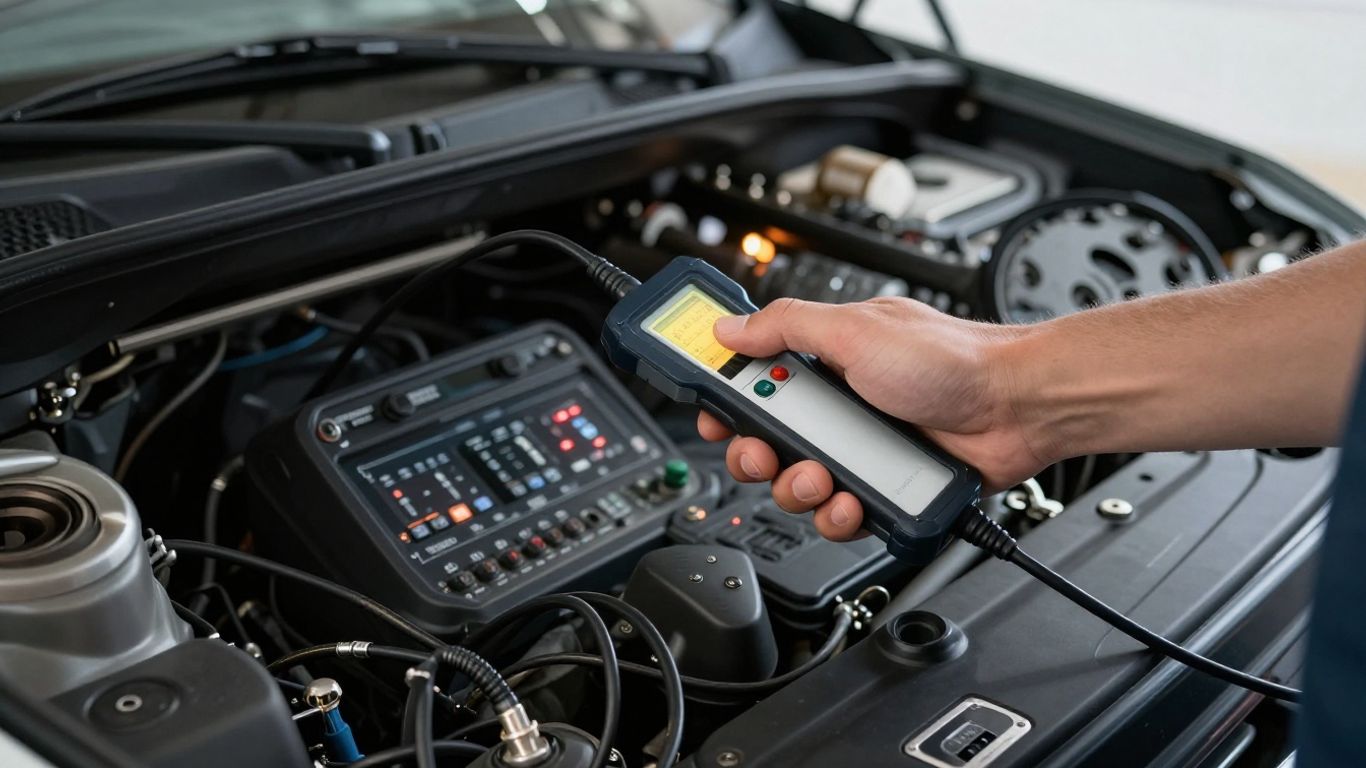
Reading trouble codes with an OBD-II scanner
Connect the scanner with the ignition off unless the equipment instructions say otherwise, then perform a complete scan. Record current, pending, and communication-related codes, along with freeze-frame information when available.
Clearing codes too early removes clues about what happened first. Save or photograph the report before making repairs.
Checking whether the scanner can communicate with the ECU
If the scanner cannot connect to the ECU, check the diagnostic connector’s power and ground, the relevant fuses, and the vehicle battery. Then investigate network wiring and module power before declaring the ECU dead.
If the scanner connects but data is implausible or drops out, wiggle testing and voltage checks may reveal an intermittent connection. Communication ability is evidence, not a final pass-or-fail test.
Interpreting network, power-supply, and sensor-related codes
Network codes can reflect wiring or another module, power codes can reflect a fuse or ground, and sensor codes can reflect the sensor or its circuit. Read the code description alongside the vehicle’s wiring diagram and service procedures.
A useful diagnostic record includes the exact code, when it set, whether it returns, and which other modules reported a related fault. That pattern is usually more informative than one isolated number.
Testing ECU voltage, ground, and wiring with a multimeter
Use a wiring diagram to identify the ECU’s constant-power, switched-power, and ground circuits. Test voltage with the circuit loaded where appropriate, and perform voltage-drop checks across grounds and supply connections.
Probe carefully with suitable back-probing methods. Piercing insulation or shorting adjacent terminals can create a second problem and make the original diagnosis harder.
After the electrical checks, compare live data with the engine’s actual condition. A missing crank signal, for example, may direct the repair toward a sensor or harness instead of the ECU.
Identify common causes of ECU failure
True ECU failures do occur, but they often leave physical or historical clues. Water, excessive voltage, heat, vibration, and interrupted programming can damage a module or its connections. Treat the housing, connector, harness, and surrounding area as part of the diagnosis.
Water intrusion, corrosion, and damaged connectors
Look for moisture under covers, green or white corrosion on terminals, staining near seals, and damaged locking tabs. Water can travel along a harness, so the visible wet spot may not be the point where the fault began.
Disconnect power before inspecting connectors and follow the vehicle’s safety procedure. A clean, properly tensioned terminal may solve a communication fault without replacing the module.
Voltage spikes from incorrect jump-starting or charging
Reverse polarity, poor-quality jump leads, or an incorrectly set charger can damage sensitive electronics. A battery that was connected backward or charged during recent electrical work deserves special attention.
Ask exactly what equipment was used and how it was connected. That history can explain a sudden no-start condition and guide testing of fuses and protected power circuits.
Overheating, vibration, and internal circuit damage
Repeated heat cycles, engine-bay vibration, and age can damage solder joints or internal components. Symptoms may appear only when the vehicle is hot or after vibration, then disappear temporarily after cooling.
A module that has failed internally should be confirmed through power, ground, communication, and output tests. Replacing it without those checks risks repeating the same failure.
Software faults, programming errors, and immobilizer issues
Interrupted programming, incorrect calibration, or a mismatch between modules can cause no communication or no-start symptoms. Security pairing can also prevent the engine from running even when the ECU itself is electrically sound.
The repair record should identify whether the issue is software, configuration, authorization, or hardware. Those are different repairs with different costs and procedures.
Decide whether the ECU needs repair or replacement
The right repair depends on what the tests prove. A damaged wire, terminal, fuse, or ground is usually addressed at the vehicle level, while a confirmed internal fault may require module repair or replacement. Keep the original diagnostic report with any estimate.
When wiring or connector repairs can solve the problem
Repairing a broken power feed, corroded terminal, or damaged data wire can restore normal operation without touching the ECU. Connector replacement may be appropriate when terminals are loose, overheated, or no longer seal correctly.
The repair should include a verification test afterward. Confirm communication, clear only relevant codes, and check whether the original starting symptom has disappeared.
Situations that require ECU reprogramming or relearning
Some repairs require software updates, configuration, throttle or idle relearning, or synchronization with other modules. The exact procedure depends on the vehicle and the replacement or repaired component.
Do not disconnect a programming tool prematurely or rely on a generic procedure. Stable voltage and the correct service information are essential during programming.
Comparing module repair with a replacement ECU
Module repair can preserve the original configuration when the hardware is repairable. Replacement may be sensible when the damage is extensive, the module is unavailable for repair, or a properly matched unit is more practical.
Compare warranty, testing method, programming requirements, turnaround time, and the total installed cost. The cheapest box alone is not a meaningful comparison.
Why compatible software and immobilizer matching matter
An ECU with the wrong software or security data may communicate yet still prevent starting or create new faults. Matching part numbers is only one step; the vehicle’s configuration and required relearn procedures also matter.
Ask who will program the module and how compatibility will be verified. A professional should be able to explain what will be copied, configured, or relearned without promising success before testing.
Know when to use a professional diagnostic service
Professional help is sensible when the vehicle has multiple communication codes, suspected water damage, an immobilizer fault, or a programming need. It is also wise when basic checks have not isolated the fault. Modern starting systems can be damaged by an otherwise well-intended test.
Tests that require manufacturer-level scan equipment
Some vehicles need access to module-specific data, guided tests, security functions, or programming systems that a basic code reader cannot provide. Manufacturer-level equipment can also show whether a module is online and what messages it is receiving.
Ask the shop what test will distinguish an ECU fault from a wiring, sensor, or network fault. A clear answer is more valuable than a confident parts recommendation.
Risks of probing circuits or replacing modules blindly
Incorrect meter connections, test lights on sensitive circuits, and forced connector probes can damage terminals or electronics. Blind replacement may add programming costs while leaving the original power or network problem untouched.
Stop testing if a connector becomes hot, a fuse repeatedly blows, or smoke appears. At that point, towing is safer than continued experimentation.
Information to gather before visiting a repair shop
Bring the vehicle identification number, exact symptoms, scan reports, recent repair history, battery-test results, and details about jump-starts or water exposure. Note whether the engine cranks, whether security lights flash, and whether the symptom is intermittent.
For broader preparation, this car-starting checklist can help organize the basic observations. Keep the description factual and avoid leading the technician toward an ECU diagnosis.
How to evaluate an ECU diagnosis and repair estimate
A sound estimate should state the confirmed fault, tests performed, parts or services required, programming needs, warranty, and what happens if the module does not solve the no-start condition. It should separate diagnosis from repair rather than presenting a replacement as proof.
Before approving work, ask whether the shop tested ECU power, ground, communication, and the main starting inputs. Also ask what caused the failure and whether that cause must be repaired to protect the replacement.
The same careful approach applies to any electrical job: verify the evidence, understand the proposed repair, and avoid treating working accessories as proof that the whole vehicle electrical system is healthy. Even advice about electrical trade protection, professional certification, community guidelines, supplier documentation, or quality-control testing belongs to a different subject; the vehicle diagnosis itself should remain grounded in measured results.
Conclusion
A car that will not start with a seemingly good battery may have an ECU problem, but it may just as easily have a weak connection, starter fault, missing sensor signal, fuel issue, or immobilizer concern. Separate crank from no-crank, test the basic circuits, scan for communication, and confirm power and ground before choosing repair or replacement. That method is slower than guessing, but it is far more likely to produce the right fix.
Frequently Asked Questions
Can a car have a good battery and still fail to start?
Yes. A good battery does not rule out a starter, ignition, fuel, sensor, immobilizer, wiring, or ECU-related fault.
What is the difference between crank-no-start and no-crank?
Crank-no-start means the starter turns the engine but it does not run. No-crank means the starter does not turn the engine at all.
Do working headlights prove the battery is healthy?
No. Headlights draw power differently from the starter, and a battery or connection can fail when subjected to starter load.
Will an OBD-II scanner identify a bad ECU automatically?
No. It may show codes or a communication failure, but power, grounds, wiring, sensors, and other modules must also be tested.
Can a faulty sensor look like an ECU failure?
Yes. A missing crankshaft signal or a shorted sensor circuit can prevent starting or disrupt communication without an internally failed ECU.
Does a replacement ECU always work immediately?
No. It may require compatible software, configuration, immobilizer matching, and relearning before the vehicle will start normally.
When should I stop diagnosing the problem myself?
Stop when testing involves security programming, network wiring, repeated fuse failures, water-damaged electronics, or measurements you cannot safely interpret. A qualified diagnostic service can prevent additional damage.